Three-Wheeler Components: Durability Demands of Commercial Use
A private car might run a few thousand kilometres a year at gentle loads. A commercial three-wheeler, whether a passenger auto, a cargo carrier, or an e-rickshaw, may be on the road ten to twelve hours a day, six or seven days a week. It carries more than its rated load, takes potholes without slowing, and gets serviced only when something goes wrong.
For a three-wheeler, durability is not a premium feature. It decides whether the vehicle earns money or sits in a garage.
Why Commercial Use Is So Demanding
Long running hours. Daily duty cycles are far heavier than in personal use. Components accumulate fatigue cycles and wear in months rather than years.
Frequent overloading. Extra passengers or cargo beyond the design rating are common. Every overload raises stress on the axle, suspension, frame, and brakes.
Stop-start traffic. City operation means constant clutch engagement, gear changes, and braking. This is hard on transmission parts, brake systems, and the driveline.
Poor road surfaces. Potholes, speed breakers, and broken roads send repeated shock loads through the chassis and suspension.
Harsh environments. Dust, heat, monsoon water, and sometimes road salt or chemical exposure accelerate corrosion and abrasive wear.
Limited maintenance. Many owner-operators balance uptime against cost, so lubrication and inspection intervals may stretch beyond the ideal. Parts must tolerate this without early failure.
Key Components and What They Face
Crankshaft and connecting rod
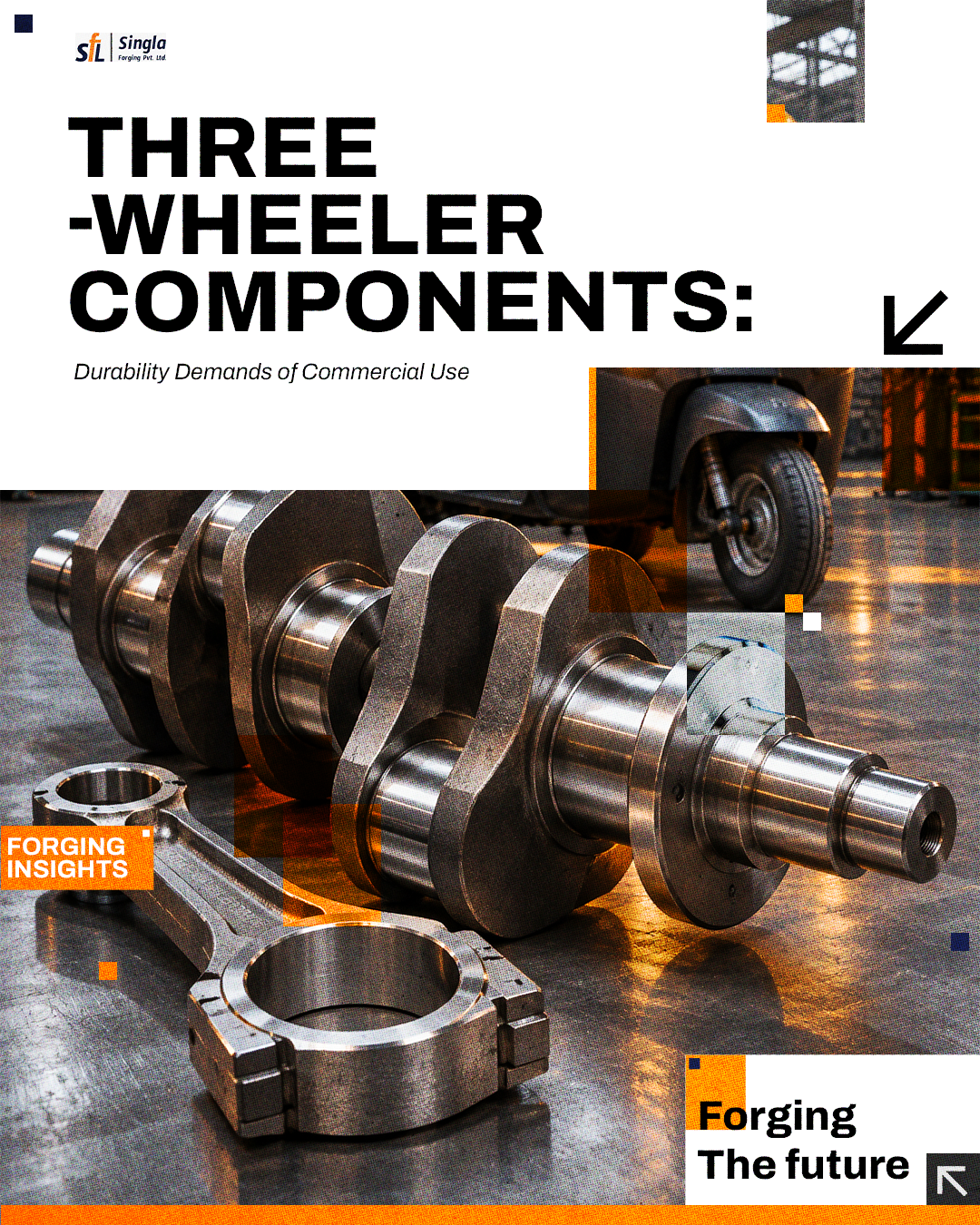
These carry the engine’s cyclic combustion loads. Fatigue is the main concern, usually starting at fillets, oil holes, and changes in section. Material cleanliness, grain flow, and surface treatment strongly influence life.
Transmission gears and shafts
Frequent gear changes and heavy loads create high contact stress and bending stress at the tooth root. Case hardening and precise heat treatment help gears resist pitting, wear, and tooth breakage.
Axles and differential parts
The rear axle carries vehicle weight, passenger or cargo load, and drive torque at once. Bending and torsional fatigue are the risks, and overloading makes them worse.
Front fork, steering and stub components
These parts handle impact from the road and steering forces together. They are safety-critical, so toughness matters as much as strength. A part that is strong but brittle is a hazard.
Suspension components
Springs, shock absorbers, bushes, and mounting brackets work through constant cyclic loading. Spring fatigue, bush wear, and bracket cracking are common failure patterns on rough roads.
Brake system
Drums, shoes, linings, and actuation parts face heat, wear, and water ingress. Consistent friction and resistance to heat fade are essential, particularly with heavy loads on descents.
Chassis and frame
The frame is the backbone. Weld quality, joint design, and material choice decide whether it resists cracking after years of twisting and vibration.
Fasteners and small parts
Bolts, studs, pins, and clips look minor but carry real loads. Loosening from vibration and fatigue failure of fasteners are frequent causes of breakdowns.
What Makes a Component Durable
Right material, right processing. The alloy sets the potential, but forging, heat treatment, and surface finishing decide how much of it is realised. For highly stressed parts, forging offers favourable grain flow and a denser internal structure.
Good design details. Generous radii, smooth section transitions, and sensible load paths reduce stress concentration, which is where most fatigue cracks begin.
Surface engineering. Case hardening, shot peening, nitriding, and protective coatings improve wear and fatigue resistance and slow corrosion.
Tight, consistent manufacturing. Dimensional accuracy and repeatable quality matter because small variations in fit or hardness can shorten life in tough duty cycles.
Validation under real conditions. Bench fatigue tests, durability trials, and field feedback show how a part behaves under actual commercial use, not just on paper.
The Electric Three-Wheeler Shift
Electric three-wheelers change the picture without removing the durability challenge. Instant motor torque loads the driveline differently, battery weight raises the load on axles and suspension, and vibration patterns shift. Components designed for combustion engines may need re-evaluation, and new parts such as motor shafts, reduction gears, and battery mounting structures bring their own durability requirements.
Cost vs. Durability
Three-wheeler buyers are price-sensitive, so the challenge is delivering durability without pushing cost out of reach. The best answer is usually not a heavier or more expensive part but a smarter one: better material cleanliness, better process control, and design refinement. A component that lasts longer lowers the cost per kilometre, and that is the number commercial operators actually care about.
Conclusion
In commercial three-wheeler use, every component is tested daily by overload, rough roads, heat, and limited maintenance. Durability comes from the combination of sound design, the right material, controlled manufacturing, and real-world validation. For manufacturers and suppliers, building parts that keep vehicles earning, day after day, is the strongest advantage there is.