The Science Behind Fatigue Resistance in Forged Automotive Parts
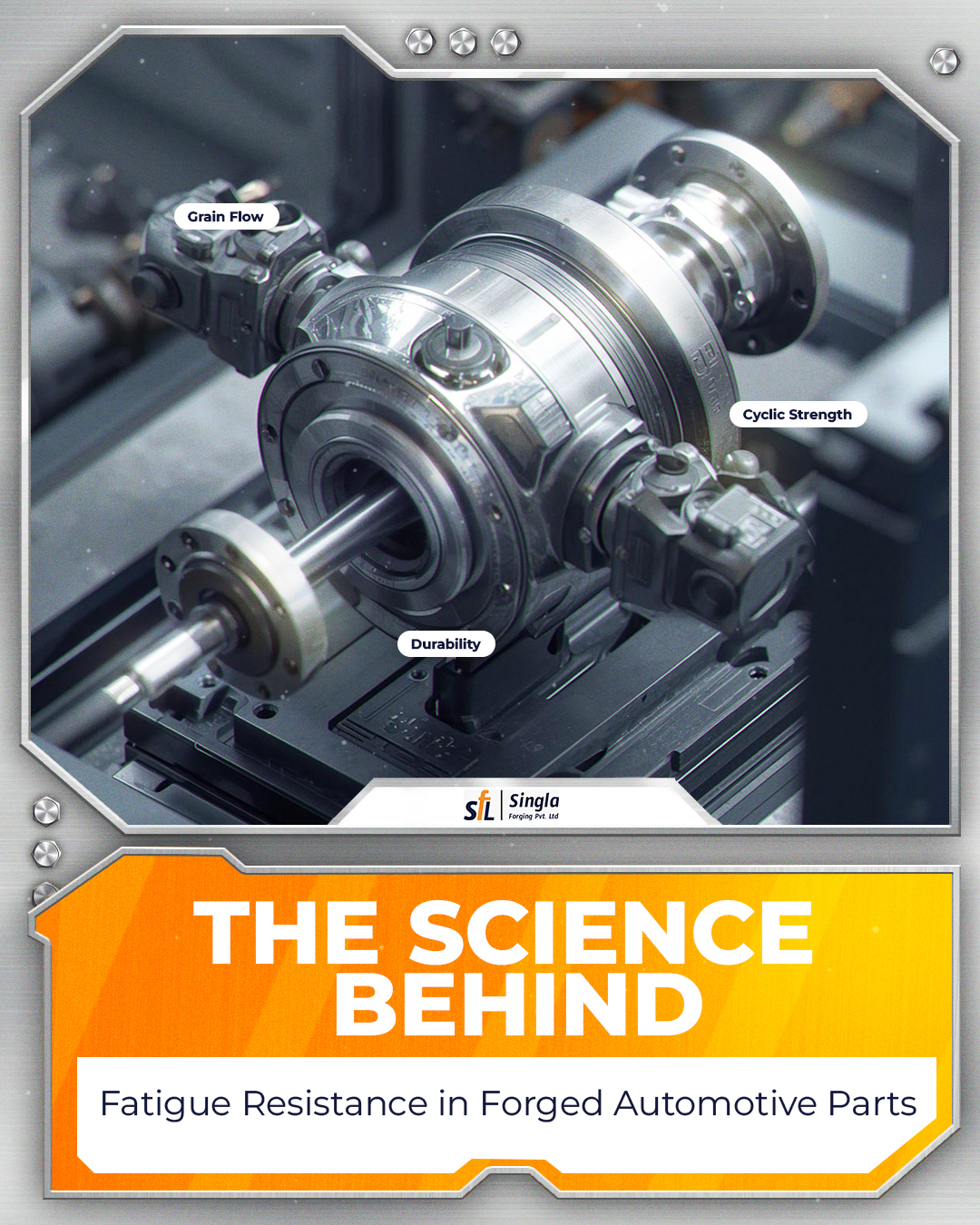
In the demanding world of automotive engineering, components are constantly subjected to dynamic stresses, extreme temperatures, and variable loads. Whether it’s a high-performance suspension arm or a critical drivetrain component, the ability of a part to resist fatigue—the progressive and localized structural damage that occurs when a material is subjected to cyclic loading—is essential for safety, durability, and long-term performance. At Singla Forging, we leverage advanced forging science to enhance fatigue resistance in every automotive part we produce.
Understanding Fatigue in Automotive Components
Fatigue is a subtle adversary—it doesn’t always cause immediate failure but gradually weakens a part over time. In automotive applications, components like crankshafts, gears, control arms, and connecting rods experience millions of load cycles during their service life. Even stresses below the material’s ultimate tensile strength can lead to fatigue cracks if repeated enough times.
Automotive fatigue failure typically occurs in three stages:
- Crack Initiation: Microstructural imperfections, surface irregularities, or stress concentrators act as initiation sites.
- Crack Propagation: Once formed, cracks grow incrementally under cyclic stress.
- Final Fracture: When the remaining cross-section can no longer support the load, rapid failure occurs.
Why Forging Improves Fatigue Resistance
Forging is one of the most effective manufacturing processes for enhancing fatigue resistance in automotive parts. Unlike casting or machining from solid billets, forging aligns the metal’s internal grain flow to match the shape and stress paths of the finished component. This alignment leads to several key advantages:
1. Improved Grain Structure
Forging refines the internal grain structure by deforming the metal under high pressure. This results in:
- Continuity of grains along load paths
- Reduction of internal voids and inclusions
- Enhanced directional strength
Grains that follow the component’s geometry help distribute cyclic loads more evenly, reducing stress concentrations that lead to fatigue.
2. Increased Density and Reduced Defects
Forged parts have significantly fewer porosities and micro-faults than cast or welded parts. These microscopic defects often act as crack initiation points under repeated loading. By minimizing such imperfections, forging directly improves fatigue life.
3. Work Hardening and Residual Stresses
The forging process induces beneficial residual stresses and work hardening at the surface, where fatigue cracks typically start. These compressive stresses counteract the tensile stresses experienced during service, delaying crack initiation and slowing propagation.
Metallurgical Controls for Enhanced Fatigue Performance
At Singla Forging, fatigue resistance isn’t left to chance—we optimize the metallurgical processes to ensure maximum performance:
Alloy Selection
Choosing alloys with high tensile strength and ductility is critical. Automotive applications often use medium- to high-carbon steels, alloy steels (like chromium-molybdenum or nickel steels), and heat-treatable grades that balance strength and toughness.
Heat Treatment Optimization
Controlled heat treatments like quenching and tempering refine microstructures and eliminate residual stresses. This enhances both the static strength and the dynamic fatigue properties of the part.
Surface Conditioning
Surface treatments such as shot peening, polishing, or induction hardening introduce compressive surface stresses and remove micro-notches. These treatments significantly enhance fatigue resistance by reducing stress raisers at the surface.
Design Considerations That Boost Fatigue Life
Engineering design and forging go hand-in-hand. Fatigue resistance is also influenced by:
- Smooth transitions between geometries to avoid abrupt stress concentrations
- Optimized fillet radii and cross-sectional shapes
- Balanced mass and stiffness distribution
Finite Element Analysis (FEA) and fatigue simulation tools allow engineers to predict stress distributions and refine designs before metal ever enters the forge press.
Real-World Impact: Safety, Reliability & Cost Efficiency
Fatigue failure isn’t just a technical concern—it has direct implications for safety, maintenance costs, and vehicle reliability. High fatigue resistance means:
- Longer service intervals
- Reduced risk of catastrophic part failure
- Better performance in demanding conditions
For automotive OEMs and Tier-1 suppliers, ensuring that forged parts can withstand millions of cycles without degradation is a competitive advantage.
Conclusion
Fatigue resistance in forged automotive parts is the result of science, engineering precision, and process mastery. By leveraging advanced forging techniques, refined metallurgical control, and thoughtful design practices, Singla Forging delivers components that stand up to the most rigorous cyclic stresses found in automotive applications.
When strength, reliability, and performance matter most, the science of forging ensures your parts are built to last.