How to Reduce Weight Without Losing Strength in Forged Components
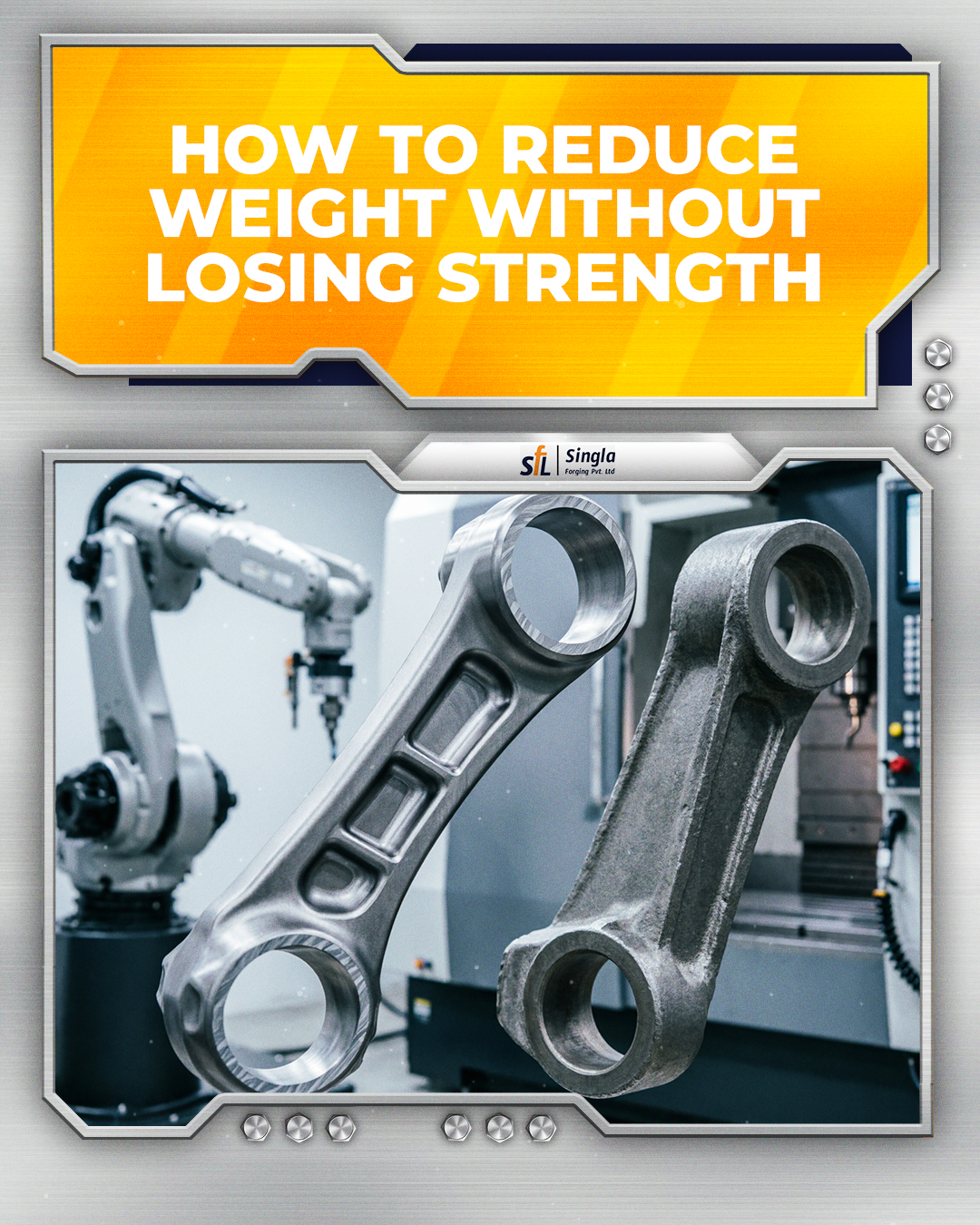
Modern automotive manufacturers are under constant pressure to make vehicles lighter, more efficient, and more responsive. At the same time, components must continue to withstand high loads, vibration, impact, and repeated stress. This creates an important engineering challenge: how can the weight of a forged component be reduced without sacrificing its strength and durability?
Forging provides an effective route to achieving this balance. With the right combination of material selection, component geometry, forging technology, and process control, manufacturers can develop parts that use less material while maintaining the mechanical performance required for demanding applications.
Why Lightweight Forged Components Matter
Reducing the weight of individual components can contribute to overall vehicle weight reduction. Lighter parts can help improve fuel efficiency in conventional vehicles and support energy efficiency in electric vehicles.
However, simply removing material is not enough. A component that becomes lighter but loses its ability to handle operational loads can create reliability and safety concerns. The objective is therefore optimized weight rather than minimum weight.
Forging is particularly suitable for this approach because the process can produce components with controlled material flow and strong mechanical properties. Properly designed forged parts can achieve an excellent balance between weight, strength, fatigue resistance, and service life.
1. Start With the Right Material
Material selection is one of the first decisions that influences the strength-to-weight ratio of a forged component.
High-strength steels, alloy steels, micro-alloyed grades, and aluminium alloys can be selected according to the component's application and loading conditions. A stronger material can sometimes allow engineers to reduce cross-sectional dimensions while maintaining the required performance.
The material should not be selected based only on its maximum strength. Ductility, toughness, fatigue behavior, hardness, machinability, and heat-treatment response are also important considerations.
For this reason, material selection should be closely connected with the component's actual operating environment.
2. Optimize the Component Geometry
One of the most effective ways to reduce weight is to place material where it contributes most to structural performance.
Instead of maintaining the same thickness throughout a component, engineers can use optimized sections, controlled transitions, ribs, fillets, and other geometric features. Areas experiencing higher loads can retain additional material, while low-stress regions may be reduced.
This approach allows the component to maintain its load-bearing capability without carrying unnecessary mass.
Computer-aided engineering and simulation can support this process by helping engineers understand how forces and stresses move through the component before production tooling is finalized.
3. Use Forging to Control Material Flow
The way metal flows during forging has a major influence on component performance.
A well-designed forging process can guide the material flow so that it follows the general shape and load paths of the finished component. This can contribute to improved structural integrity and fatigue performance.
Die design is therefore an important part of lightweight component development. Proper die geometry can help achieve the desired shape while controlling excess material and avoiding unnecessary machining allowances.
Singla Forging's manufacturing capabilities include cold, warm, and hot forging, allowing the appropriate process to be considered according to component requirements.
4. Consider Heat Treatment Carefully
Weight reduction should always be evaluated together with the required mechanical properties.
Heat treatment can be used to achieve the desired combination of hardness, strength, toughness, and fatigue performance. The appropriate treatment depends on the material grade and component application.
A carefully controlled heat-treatment process can help a lighter component achieve the mechanical properties needed for service. This is especially important for automotive components exposed to repeated loading and demanding operating conditions.
Singla Forging also lists dedicated heat-treatment facilities as part of its manufacturing capabilities.
5. Reduce Machining Allowances
Another opportunity for weight and material efficiency comes from controlling the amount of material that must be removed after forging.
Precision forging and accurate die design can bring the forged shape closer to the final component geometry. This can reduce machining requirements, material waste, and unnecessary stock.
The benefit is not only lower material consumption. Less machining can also contribute to improved production efficiency and more consistent component dimensions.
For applications requiring close dimensional control, forging can be combined with precision CNC machining and other finishing operations.
6. Validate Strength Before Reducing Material
Lightweighting should always be supported by engineering validation.
Before reducing a section or changing a material, manufacturers need to understand the loads the component will experience during its service life. Stress analysis, fatigue evaluation, dimensional inspection, material testing, and other validation methods can help determine whether the redesigned component meets its performance requirements.
This is particularly important for safety-critical automotive parts, where a small design change can affect stress distribution and fatigue behavior.
7. Balance Weight, Cost, and Manufacturing Feasibility
A design that is extremely lightweight may not always be the most practical solution. Complex tooling, difficult manufacturing conditions, increased inspection requirements, or expensive materials can offset the benefits of weight reduction.
The best approach is to consider design, material, forging process, machining, heat treatment, quality control, and production volume together.
This integrated approach allows manufacturers to develop components that are not only lighter but also practical to manufacture consistently at production scale.
The Role of an Experienced Forging Partner
Successful lightweighting requires more than simply changing the dimensions of an existing part. It involves understanding material behavior, forging technology, die design, heat treatment, machining, and quality requirements.
Singla Forging has experience across hot forging, cold forging, warm forging, cold forming, and aluminium forging, supported by product development, precision machining, heat treatment, and inspection capabilities.
Conclusion
Reducing the weight of forged components without compromising strength requires a carefully engineered approach. The right material, optimized geometry, controlled metal flow, appropriate heat treatment, efficient machining, and thorough validation all contribute to achieving the desired strength-to-weight ratio.
For automotive manufacturers, lightweight forged components can support broader goals such as improved efficiency, performance, and resource utilization. The key is not simply to use less metal, but to use the right amount of material in the right places while maintaining the required mechanical performance.
With advanced forging technologies and an engineering-focused manufacturing approach, lightweighting can become a practical part of developing stronger, more efficient automotive components.