How to Extend Die Life and Reduce Cost per Forged Part
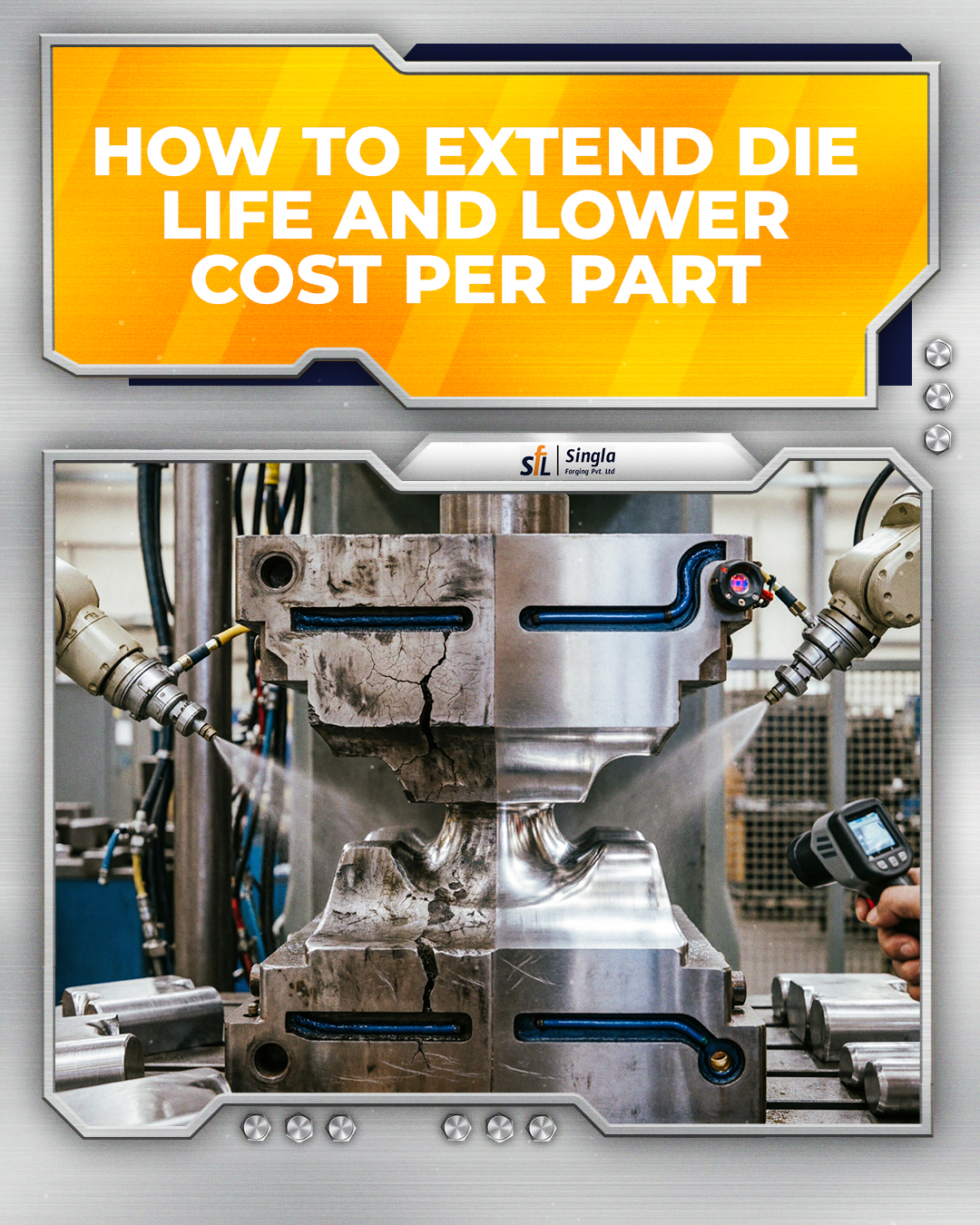
In forging, dies play a critical role in determining both product quality and manufacturing cost. Every forging cycle places significant mechanical and thermal stress on the tooling. Over time, this can result in wear, cracking, dimensional variation, and eventually die failure. When dies need frequent replacement or repair, the impact is felt directly in tooling expenses, machine downtime, production delays, and cost per component.
The good news is that proper die design, maintenance, process control, and monitoring can significantly improve tooling performance. For manufacturers producing components in high volumes, even a modest increase in die life can create meaningful savings across an entire production program.
1. Start With the Right Die Design
Die life begins long before the die enters production. A well-engineered die distributes forging loads effectively and supports smooth material flow through the cavity.
Sharp corners, sudden changes in section thickness, inadequate radii, or poorly positioned parting lines can create localized stress concentrations. These areas may become starting points for cracks or accelerated wear.
Modern die-development methods, including CAD/CAM and forging simulation, allow engineers to study material flow and identify potential problem areas before manufacturing the tooling. Optimizing cavity geometry, draft angles, radii, and flash design can reduce unnecessary loading and improve overall tool performance.
Singla Forging's engineering and tool-room capabilities support precision tooling development and maintenance, helping manufacturers maintain consistency during production.
2. Choose Suitable Die Materials and Treatments
Die material has a direct influence on service life. The selected tool steel or other die material needs to withstand the specific combination of impact, compression, friction, and temperature involved in the forging process.
Heat treatment is equally important. Incorrect hardness or inadequate heat treatment can leave dies vulnerable to premature cracking, deformation, or wear. Depending on the application, suitable surface treatments or coatings may also be considered to improve resistance against wear and friction.
The objective should not simply be to choose the hardest possible material. Instead, the die needs the right balance of toughness, hardness, thermal stability, and wear resistance for its operating conditions.
3. Maintain Consistent Forging Conditions
Unstable process conditions can shorten die life considerably. Variations in billet temperature, deformation, lubrication, press settings, or cycle time can expose tooling to inconsistent loads.
For hot and warm forging, maintaining the correct material temperature is particularly important. Excessive temperatures can increase thermal loading and oxidation, while insufficient temperatures may require greater forming forces.
Consistent process parameters help keep die loading predictable. Standardized operating procedures and process monitoring can therefore contribute not only to component quality but also to longer tooling life.
4. Improve Lubrication and Reduce Friction
Friction between the workpiece and die surface affects both metal flow and tooling wear. Poor or inconsistent lubrication can increase friction, raise surface temperatures, and accelerate deterioration of the die cavity.
Using the appropriate lubricant and applying it consistently can help control friction and improve material movement. Lubrication practices should be monitored rather than treated as a routine step with no process control.
The correct lubrication strategy depends on the forging process, material, die temperature, production speed, and tooling configuration.
5. Use Preventive Die Maintenance
Waiting until a die fails is generally more expensive than maintaining it proactively. Small cracks, localized wear, or dimensional changes can often be identified before they become major tooling problems.
Regular inspection should focus on areas such as:
- Die cavity wear
- Cracks and heat checking
- Surface damage
- Parting-line condition
- Alignment
- Critical dimensions
- Surface finish
Preventive maintenance can allow worn areas to be repaired or reworked before they affect a large batch of components. Singla Forging's tool room is equipped for tool development, maintenance, repair, surface grinding, EDM, wire cutting, and tool sharpening, supporting longer-term tooling availability.
6. Monitor Die Life Using Production Data
A die should not be replaced simply because it has reached an arbitrary number of strokes. Actual production data can provide a better understanding of tooling performance.
Manufacturers can track the number of components produced, maintenance interventions, cavity measurements, defect rates, and failure patterns for individual dies. This information can reveal when a die typically begins showing measurable wear.
With historical data, maintenance teams can schedule inspections and refurbishment at appropriate intervals instead of relying entirely on emergency repairs.
7. Control Die Alignment and Machine Setup
Even a well-designed die can suffer premature wear if the tooling is incorrectly installed or the forging equipment is not properly aligned.
Misalignment can cause uneven loading across the die surfaces, producing localized wear and dimensional variation. Regular checks of die alignment, guides, holders, and machine condition can help prevent these problems.
Correct setup also contributes to repeatable forging conditions and reduces the possibility of producing defective components.
8. Reduce Defects to Lower the True Cost per Part
Die life and cost per part are closely connected. A longer-lasting die does not automatically deliver savings if the process continues to generate defects, rework, or excessive downtime.
A practical cost-per-part calculation should consider more than the purchase price of the die. It can include:
Cost per part = tooling cost + maintenance + downtime + scrap/rework + production costs ÷ good parts produced
This makes it clear why improving die performance can have benefits beyond reducing tooling replacement expenses.
Better die design and process control can help reduce defects, improve consistency, and increase the number of acceptable components produced from each tooling set. Singla Forging emphasizes defect prevention, process optimization, dimensional inspection, and advanced testing as part of its quality approach.
9. Treat Tooling as a Continuous Improvement Opportunity
Die management should not end after a production run. Data from every batch can be used to improve future tooling.
If a particular cavity consistently develops wear in one location, engineers can investigate the underlying cause. The solution may involve modifying the die geometry, changing lubrication, adjusting process parameters, improving material flow, or selecting a different die material or treatment.
This continuous-improvement approach turns tooling data into a valuable manufacturing resource.
Conclusion
Extending die life is not about relying on one solution. It requires a combination of intelligent die design, suitable materials, controlled forging conditions, effective lubrication, preventive maintenance, accurate machine setup, and production data analysis.
For high-volume forging operations, these improvements can reduce tooling interruptions, improve component consistency, limit scrap, and ultimately lower the cost associated with producing each acceptable part.
At Singla Forging, advanced manufacturing capabilities and an in-house tool room support the development, maintenance, and repair of precision tooling. By treating die performance as an important part of the overall manufacturing strategy, forging manufacturers can achieve greater reliability, productivity, and cost efficiency over the complete production lifecycle.