How Process Standardization Improves Product Consistency
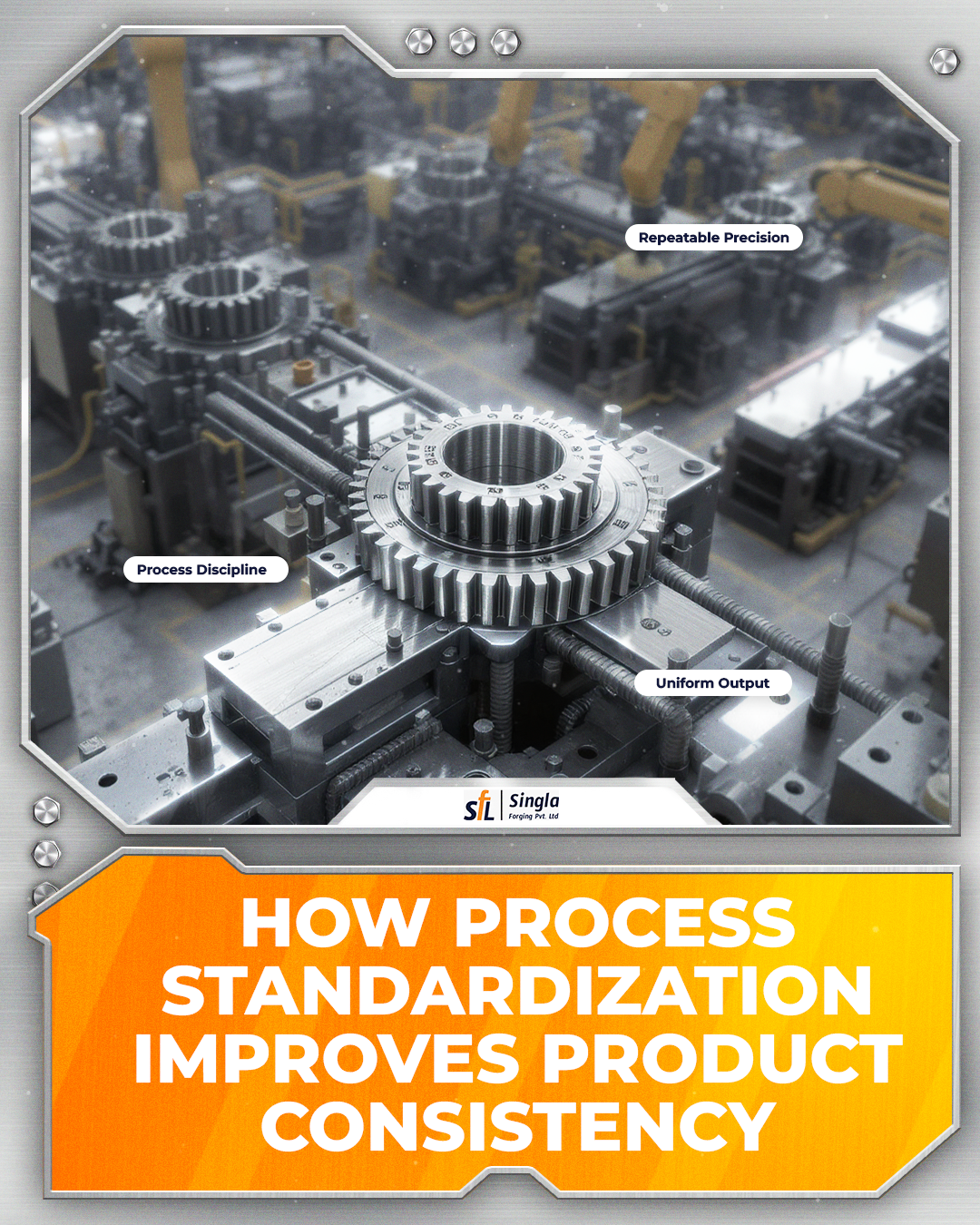
In today’s competitive manufacturing landscape, consistency is not just a quality benchmark—it is a business necessity. Customers expect every product to meet the same specifications, performance standards, and reliability levels, regardless of when or where it is produced. This is where process standardization becomes a critical pillar of success.
For industries like forging, where precision, strength, and repeatability define product quality, standardizing processes ensures that every component meets exacting standards without variation.
What is Process Standardization?
Process standardization refers to the practice of defining and implementing a uniform method for performing tasks and operations across an organization. It involves documenting workflows, setting clear guidelines, and ensuring that every team member follows the same procedures.
In manufacturing, this includes standardized:
- Work instructions
- Machine settings
- Quality parameters
- Inspection procedures
By aligning these elements, companies create a repeatable production system that minimizes variability and improves control.
The Link Between Standardization and Product Consistency
Product inconsistency often arises from small variations—differences in operator methods, machine calibration, or material handling. Over time, these minor deviations can lead to defects, rework, or customer dissatisfaction.
Process standardization addresses this challenge by ensuring that:
- Each operation follows a uniform and predefined method.
- Every parameter is controlled and documented
- Every output meets predefined quality benchmarks
When processes are consistent, products naturally become consistent.
Key Ways Process Standardization Enhances Product Consistency
1. Reduces Variability in Production
Standardization eliminates guesswork by defining the “best way” to perform each task. Employees no longer rely on personal judgment or experience alone, which significantly reduces inconsistencies.
When every operator follows identical procedures, the outcome becomes predictable and repeatable—two essential factors for consistent product quality.
2. Ensures Uniform Quality Standards
Standardized processes embed quality into every stage of production. From raw material selection to final inspection, each step follows predefined specifications.
This ensures that:
- Quality is integrated into every step, not just verified at the final stage.
- Defects are minimized at the source
- Output remains uniform, meeting established standards across every batch.
As a result, organizations can guarantee consistent output across batches and production lines.
3. Minimizes Human Error
Human error is one of the biggest causes of inconsistency in manufacturing. Without clear guidelines, employees may interpret tasks differently, leading to variations in results.
Standardization reduces this risk by:
- Providing clear instructions
- Defining exact process parameters
- Eliminating ambiguity
This structured approach significantly lowers error rates and improves reliability.
4. Improves Process Control and Monitoring
When processes are standardized, they become easier to monitor and measure. Manufacturers can track performance using consistent benchmarks and quickly identify deviations.
This enables:
- Real-time quality control
- Faster corrective actions
- Continuous process improvement
A standardized system creates better visibility, allowing companies to maintain tighter control over product quality.
5. Enhances Training and Workforce Efficiency
Training new employees becomes much simpler when processes are standardized. Instead of learning multiple methods, workers are trained on a single, optimized approach.
Benefits include:
- Faster onboarding
- Reduced skill gaps
- Consistent performance across teams
A well-trained workforce following standardized procedures contributes directly to uniform product quality.
6. Supports Scalability and Growth
As businesses expand, maintaining consistency becomes more challenging. Without standardization, different plants or teams may develop their own methods, leading to uneven quality.
Standardized processes ensure that:
- Operations remain consistent across locations
- Quality does not decline with scale
- Best practices are replicated organization-wide
This is especially important for forging companies serving global markets with strict quality requirements.
7. Reduces Rework and Waste
Inconsistent processes often result in defective products, leading to rework, scrap, and increased costs.
Standardization helps:
- Identify and eliminate inefficiencies
- Reduce production errors
- Optimize resource utilization
Studies show that standardized manufacturing processes can significantly reduce errors and improve productivity, directly contributing to better quality outcomes.
Process Standardization in the Forging Industry
In forging, even minor deviations in temperature, pressure, or timing can affect the structural integrity of components. Process standardization ensures that critical parameters remain controlled throughout production.
For companies like Singla Forging Pvt. Ltd., this means:
- Consistent mechanical properties in forged parts
- Improved dimensional accuracy
- Enhanced reliability in end-use applications
By standardizing forging processes, manufacturers can deliver products that meet stringent industry standards every time.
Conclusion
Process standardization is not just about improving efficiency—it is about creating a foundation for consistent, high-quality output. By reducing variability, minimizing errors, and enforcing uniform procedures, it ensures that every product meets the same level of excellence.
In an industry where precision and reliability are non-negotiable, standardization becomes a strategic advantage. Companies that invest in well-defined, standardized processes are better equipped to deliver consistent products, build customer trust, and sustain long-term growth.